Follow the work from signal to public record.
This is the product path as it exists today: a capability assessment, an authored graph, a synthetic field exercise, a rubric review, and a credential verifier. Every example below resolves to a working route. Specimens are labeled; activation gates stay visible.
Hold or ship the support agent
BME-01 maps to n-l3-5 and publishes 4 synthetic packet sources with 4 weighted rubric dimensions.
Assessment method, authored topology, field-exercise contract previews, review architecture, and verifier routes are built.
Full lessons and field-exercise workbenches require both a signed-in account and an enrollment that includes the relevant training.
Founding cohort · applications open. Seats are reviewed rather than sold from this page.
Practitioner spot-checks and live credential defense require vetted, signed roster coverage.
Five product contracts, inspected at their boundaries.
The instrument above compresses the system into one inspectable chain. Below, each plane exposes the product mechanics an operator, practitioner, employer, or investor can inspect now, while naming the account, enrollment, and operating gates that protect the working surfaces.
- 01ASSESSMENT
Start with work, not a self-rating.
The public surface explains how three working exercises are scored against the published capability contract. The signed-in instrument runs the exercises and keeps the resulting level, dimension scores, and recommended path; that account does not by itself unlock curriculum.
Public method liveAccount for full runCAPABILITY METHOD/startInspect the public assessment method01AI literacy & judgment
02Prompting & instruction design
03Workflow decomposition
04Agent direction & oversight
05Verification & quality control
06Security & governance awareness
INPUT3 working exercisesCRITERIA15SCALE0–4 per criterionOUTPUTLevel · dimensions · path - 02THE GRAPH
Turn a score into an authored route.
Placement does not point to a generic course. It resolves against the same static curriculum graph the learner workspace renders, including every prerequisite between the current level and the target work. The authored topology is public; personal progress appears only for a signed-in learner whose training is provisioned.
Public topology liveProvisioned learner stateAUTHORED CURRICULUM TOPOLOGY/framework#topologyOpen the public topologyL03 nodesL14 nodesL216 nodesL319 nodesL47 nodesLEVELS5CURRICULUM TRACKS8NODES49PREREQUISITES58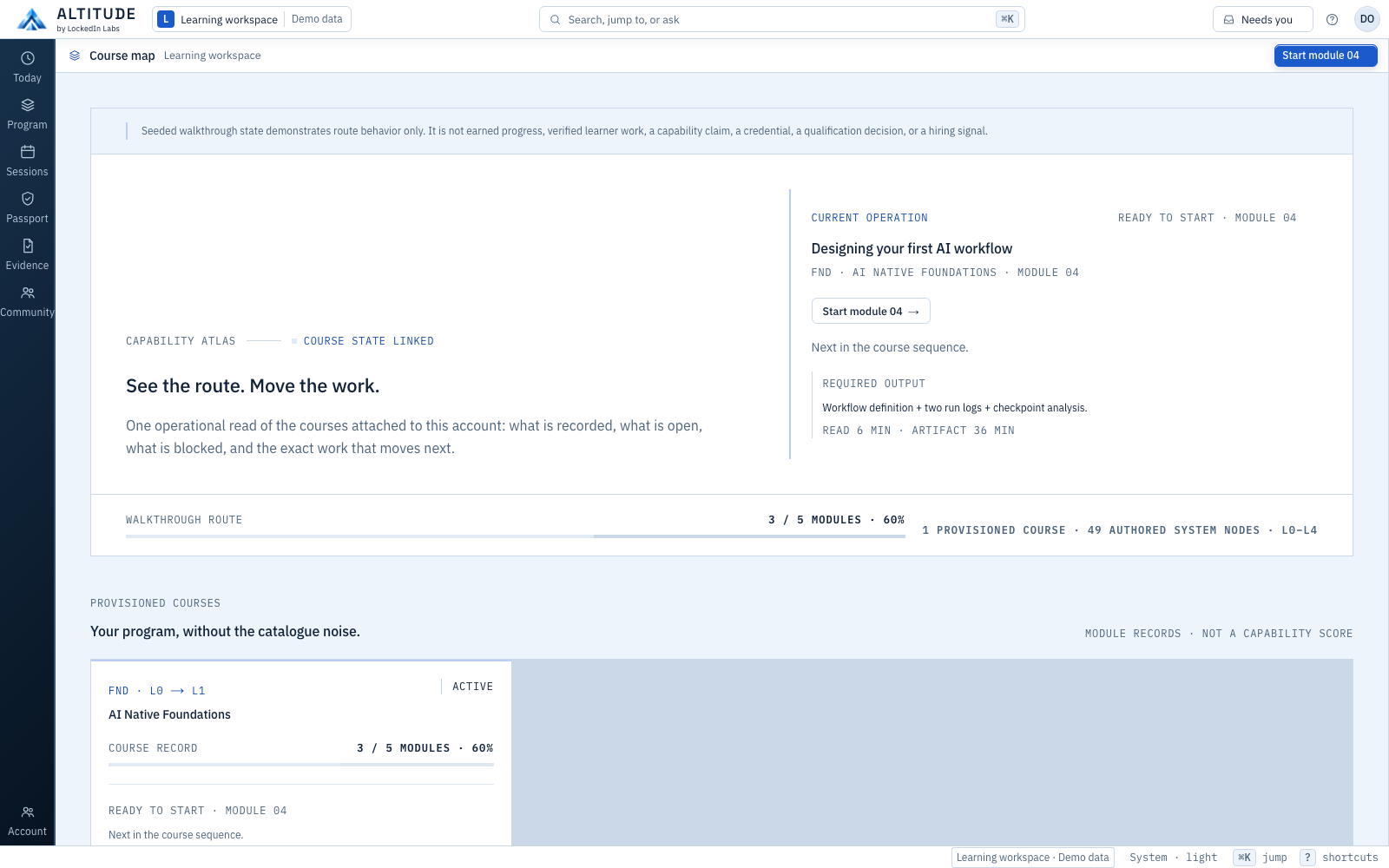
THE WORKING SURFACE · SIGNED-IN LEARNER VIEW - 03FIELD EXERCISE
Put judgment inside a controlled work packet.
Field exercises use synthetic source packets so the public surface can expose the scenario, constraints, deliverable, and rubric shape without employer data. The complete packet, workbench, attempt, and saved result require a provisioned enrollment that includes field-exercise access; an account alone is not enough.
Contract preview publicProvisioned workbenchBME-01 · SYNTHETIC WORK ENVIRONMENT/app/labs/support-agent-releaseOpen the provisioned workbenchHold or ship the support agent
Make the release call, show which evidence controls it, and define the smallest safe next run.
L335 MIN · AGISOURCE PACKETRelease briefSRC-01Published release policySRC-02Blind evaluation summarySRC-03Failure trace excerptsSRC-04PUBLISHED RUBRICDecision quality30%Evidence and math25%Failure diagnosis25%Release operations20%GRAPH NODEn-l3-5DELIVERABLERelease decision memo - 04ARTIFACT REVIEW
Make the output carry its own grading contract.
Every authored module names the artifact it expects and the rubric used to inspect it. Submission, source-labelled model review, offline fallback, portfolio state, and the expert queue are implemented. The fallback cannot pass work. Human spot-checks and live defense activate only with vetted roster coverage.
Provisioned submission workflowPractitioner review gatedRUBRIC → VERDICT → PORTFOLIO/app/portfolioOpen the signed-in evidence recordn-l3-5 · REQUIRED OUTPUTThree-layer eval suite + adversarial fix.
Evaluating agent behavior · Agentic Workflows & AI Agents
AUTHORED RUBRIC- 01Suite covers unit, trajectory, and outcome layers
- 02Adversarial case is designed to induce a real failure
- 03Results attached, including the reds
- 04Fix is verified by a rerun of the adversarial case
MODEL REVIEWSource recorded
OFFLINE CHECKCannot pass
EXPERT CHECKRoster required
- 05PUBLIC REGISTRY
Let the record resolve beyond the platform.
The verifier is public and rejects unknown IDs with a real 404. Runtime-issued credentials resolve from private learner state; the visible seed records are demonstration specimens and say so on their face. The complete specimen below exercises the same gate-to-artifact join without claiming a real holder or outcome.
Verifier liveExample is a specimenLive defense roster-gatedPUBLIC VERIFICATION RECORD/verify/AINO-D-0007Inspect the public specimenSPECIMEN · NOT AN ISSUED CREDENTIALCertified AI Native Developer
AINO-D-000714/14Linked gate nodesRECORD TYPESPECIMENDEMO HANDLEOP-217DERIVED GATE14 nodesLINKED WORK14 artifactsTRAIL EXCERPTART-22Production agent with two green eval runsART-23Three-agent orchestration with both gates evidencedART-24Three-layer eval suite and the adversarial fix
The proof architecture is public. Participation stays gated.
Inspect the method, topology, evidence contracts, and verifier without a seat. Full curriculum, workbenches, submissions, and personal state require provisioned access. Cohort access and expert participation each begin with review; nothing on this page bypasses those decisions.
Inspect the assessment method.
See the contract first; the signed-in instrument records a level and path.
Inspect the method
PRACTITIONERSApply to the roster.
Bring current work, a review standard, and a discipline.
Read the roster bar
ORGANIZATIONSInspect the operating model.
Connect role capability, delivery, evidence, and governance.
Open enterprise